QChess Gameplay
Board Layout
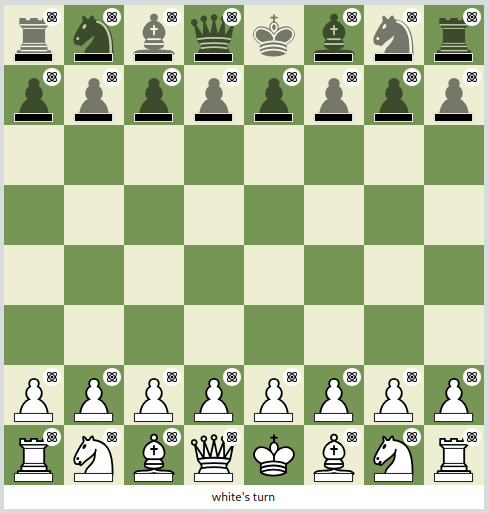
The QChess board resembles a standard chessboard, but with a key twist: all pieces, except the king, exist in a superposition of loyalty. Each piece is treated as a qubit with two collapsible states (Black and White). Players can apply quantum gates to manipulate these states, which affect the probabilities of the piece being controlled by either side.
Quantum Actions
On each turn, before making a move, the player can perform a quantum action by applying a quantum gate to any piece on the board.
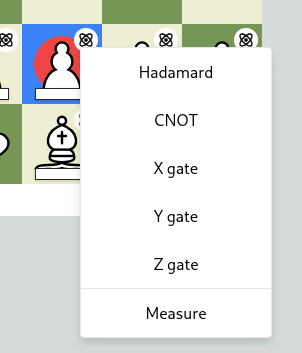
Superposition
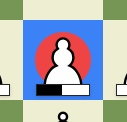
For example, applying an H-gate to a pawn puts its loyalty into a superposition of |black⟩ + |white⟩. This means there is now a 50/50 chance the pawn will switch sides when measured. The probability is reflected by a bar on the piece.
Entanglement
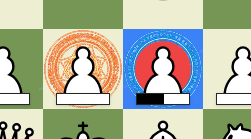
Players can entangle the loyalty of multiple pieces, typically using a combination of the H-gate and the CNOT gate. This creates a quantum correlation between the pieces. When one piece's loyalty is measured, it instantly determines the loyalty of any entangled pieces.
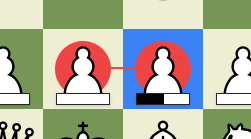
Pieces that are entangled share the same red background on the board, signifying that they are part of the same quantum circuit. A red link is formed between these pieces to indicate their quantum correlation.
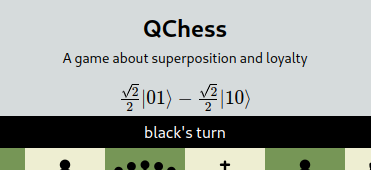
The vector state of the selected circuit is displayed at the top
Measurement and Switching Sides
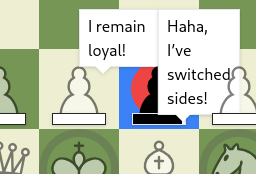
Players can only move pieces of their own color. To change a piece's color, the player must measure the piece's loyalty. Once measured, Qiskit simulates the quantum circuit, and the outcome of the measurement determines whether the piece switches sides or remains the same. Any entangled pieces are also updated based on this measurement.
Victory Condition
The game ends when a player's king is captured. Strategy and quantum manipulation of piece loyalty play a crucial role in determining the outcome of the game.